Mount Nittany Sunrise.

Sunday, January 20, 2013

Fleur-de-Babe

-->
Sometimes we just blunder into good ideas.

While family members were working on “Remembering Christmas”, holiday cards addressed to my mother were stuffing the 842 post office cubby. She had a box of cards to send in reply, but the greeting card message with the signature Marie W. Fedon seemed empty. So, I took a photo of my mom with her new Golden Retriever Sandy III in front of the Christmas tree. Then I composed an update on kids and grandkids. Still, something was missing. So, I just flat out told everyone she has dementia. Now this was no feat of courage; all the relatives know. But I was leery about being so frank with friends of hers from out of town. The cards were mailed. Life went on.

Then, January arrived, and so did the letters. The first came from Lyn, who explained that she was my mother’s freshman roommate at Slippery Rock when they were students at Penn State. (This is back in the late 1940s when apparently there wasn’t enough housing for freshmen at main campus.) After graduation, Lyn married and moved to Upstate New York. Their friendship survived the distance, with Lyn and her husband visiting my parents and their llamas in State College. Lyn asked my mom and me if she could stop by this June during Penn State’s reunion weekend…yes!

Another letter came from Carole in Boulder, CO. My mother was her art teacher at State College High.

“We called her ‘The Babe’ when she couldn’t hear us–an attractive woman not too much older than we were,” Carole wrote. Partly because of my mother’s encouragement, Carole said she studied art education at Penn State, and has taught watercolor workshops across the country for the past 30 years. Then came the true confession that had my mom and me laughing so hard tears filled our eyes. Carole, probably in 9th grade or so, lived along North Atherton Street not far from my dad’s house. Carole and her friends often spied on “The Babe” walking down to my dad’s “bachelor pad.”

Cousin Ruthie wrote about my mother’s French Silk pie. This was a light and luscious chocolate pie that was as smooth as its name—unless I was making it.  In my kitchen, French Silk pie became French Sandpaper pie—yuck! Forget the pie, it was Ruthie’s words that pulled at my heartstrings.

“There’s an Alzheimer’s wisdom that floats in and out of the mind. It helps us weather the sadness of much lost. I went to a couple of lectures on dementia. Alzheimer’s was defined as losing your life’s story. So I think it is a beautiful thing that you can give your mom’s story back to her.”

And beautiful too, that my mother’s friends have given stories back to “The Babe”, and to her children. Laurie Lynch


Still ‘The Babe’ at 84: My mom went to the bank and was helped by a clean-cut, bespectacled teller. After making the transaction, the young man laced his fingers and said, “Is there anything else I can do for you?”

“How about a kiss?” my mom replied.

Well, he was mortified. Instead of blushing, he turned pale, and mumbled that it was against the rules.

My mom smiled, turned around, and said to me, “I want to change the world. It’s too serious.”

Always Fashion-Conscious: We had a snowfall the other day and the housekeeper couldn’t make it in to keep my mom company while I was at work. So, my co-worker Sharon and I called to tell her we’d take her to lunch. Later, we were in a meeting that was interrupted with a call from my mom. She wanted to know if she should wear her fur and her new black shoes. I said, “Sure.”

She was waiting for us in the garage, hopped in the back seat, and off we went to a nearby restaurant. When we all got out of the car to go into the restaurant, I looked down at my mom’s feet. She wasn’t wearing her new black shoes…she was wearing my black cross-country ski boots!  Après-ski is quite the winter fashion statement.

Craving Crunch:  Maybe it was the rich holiday food glut or the kids-away-at-school/mid-winter blahs, but I’ve been craving raw broccoli salad. I bought a pint in the supermarket deli the other day, and then another. I just couldn’t get enough. It was chockfull of sweet dried cranberries, crunchy carrots, broccoli and nuts, with a creamy Waldorf Salad-type dressing. These ready-made salad splurges weren’t economically sustainable, so I bought two heads of broccoli, carrots, celery, red onions, and a jar of sunflower kernels. Later that night, I awoke at midnight and decided a needed some therapeutic chopping, dicing and julienning. An hour or so later, I had a raw salad that was a riot of color and feast for the craving!

No-Shrink-Needed Broccoli Salad

1 red onion, diced
2 heads fresh broccoli, sliced and chopped
3 stalks of celery, julienned
4 large carrots, julienned
½ - ¾ cup dry roasted sunflower kernels (or almonds, walnuts, hazelnuts)
¾ - 1 cup dried cranberries

Toss everything in a large bowl.

In separate bowl, blend the following:

1 cup each of mayonnaise and plain Greek yogurt
2 T lemon curd (gift from my London lady) or you could substitute the juice of one lemon and 2 T sugar. Salt and pepper to taste.

Add dressing to the salad and mix well, coating the vegetables with a thin layer of creaminess. Chill, serve and enjoy.


Tuesday, January 1, 2013

Fleur-de-RememberingChristmas

-->
About a week before Christmas my mother asked how she met my father.

I told her the well-worn tale of friends who wanted to set him up on a blind date. They gave him a choice: blonde or brunette? He picked blonde…and the rest, well, is my history.  She was teaching high school art and he was launching the State College office of a Lehigh Valley construction company. It was a whirlwind romance that resulted in a marriage of 56 wonderful years.

When I finished the story, my mother said, “I’m so glad you remember, even if you weren’t there.”

It got me thinking. She’s lost her place in the world. So many memories, names, and faces have vanished. She fills the airwaves by reading roadside signs and asking repetitive questions like a drowning person struggling to keep her head above water. Her sense of time is a jumble. Did we have Christmas yet? Happy Easter! When will it be January? Is today someone’s birthday? What day is today?

Maybe, we could remember Christmas for her.

So, I sent an email to my four sisters and spouses, and to Nonna’s 12 grandchildren, asking everyone to send holiday memories. Marina was here to help so we scoured some old albums of really embarrassing photos— the flannel-phase, the disco-phase, the perm-phase—we got holiday stickers, a few current photos fresh off Facebook, and a hardbound sketchbook to create “Remembering Christmas.”

The collection of stories, letters (the farthest came from Shanghai), and snapshots in time was wrapped and placed in Nonna’s stocking. It was a gift from all of us and for all of us. Best of all, she  loves it. Laurie Lynch

Christmas Recipe 2012: Although our family holidays are steeped in tradition, I often like to mix things up a bit, try a new recipe or add a new dish. It’s not a “Fedon” Christmas Eve unless there’s a bowl of hand-made tortellini in warm broth at each place. For years, I’ve made the family tradition my own by tossing a handful of bright green peas and chopped red pepper into the soup pot for holiday cheer.

This year, while sorting through recipe cards, I found one from Pat Snyder of Kutztown for Castagnioli (almond macaroons) that I had tasted and loved, but never baked. This was the year:

1 kilo (4½ cups) crushed almonds or almond meal (available at health food stores, Echo Hill, etc.)
4 eggs (5 if small)
2½ cups sugar
2 grated lemons (Pat uses limes)

Mix finely ground almonds, sugar, and citrus rind. Make a well in the mixture and put in eggs, stirring in from the sides. Mix well and roll into 1-inch balls. Bake at 350° for 20 to 25 minutes on parchment paper-covered baking sheets.

One batch of these cookies got a little too brown, so instead of packing them away in a tin, I placed them in a bowl for snackers and left them on the kitchen table…

Meanwhile, I had a pot of tomato sauce bubbling on the stove for dinner. I was setting the table in the dining room when Richard walked into the kitchen.

“Should I put these meatballs in the sauce?” he called out.

I freaked out, started screaming, and ran to the kitchen.

Just a joke, Mom.

My nickname for this treat will forever be “Meatball Cookies”.

Gonna Miss Him: Richard has transferred from Penn State to Vesalius College and will move to Brussels this month.

Christmas Lesson 2012: Another Christmas Eve tradition that I made my own is accompanying tortellini soup with a mixed greens salad topped with pistachios and pomegranate seeds (green-and-red theme repeated) with Sweet Fruit Dressing. Shelling the pistachios is the easy part; separating each pomegranate ruby from its casing is messy and time-consuming.

Enter Marina, fresh from grad school in London where her flat seems to be a center of culinary exchange.  (One friend, Catie, is studying the Anthropology of Food, no less!) To easily remove the seeds from a pomegranate:

1.     Slice off the “crown” end of the fruit.
2.     Cut into the skin making four quarters and gently break apart.
3.     Place the seed side in the palm of your hand and use a wooden spoon to whack the back skin side. This releases the seeds from the membrane and into your hand, and you can easily drop them into a container.

Voila! Happy 2013.

Saturday, December 8, 2012

Fleur-de-Bookworming


It was one of those lightening bolt epiphanies.

I was barely into the second chapter of How To Be a Woman and the truth plunged me into free fall. I am a 20th century woman, and hey gang, this is the 21st.

I can’t say it made me feel old. Rather, it made me feel like I missed the bus and was wandering and wondering aimlessly in the 1970s and 1980s. Just a few written pages let me know I was a transistor radio in an age of iPods.

As I go about regaining my equilibrium, I will stray a bit from the usual topics of gardening and gathering. I’ll share with you the stack of books on my bedside dresser competing for space with my wind-up alarm clock, tissues, wristwatch, reading glasses, calming lavender sachet, Hurricane Sandy flashlight, and Tiger Balm – my nighttime essentials.

I have my “chef-phew” (chef-nephew) to thank for Katie Couric’s The Best Advice I Ever Got. When we got together with Wille in September at Rouge Tomate, he was raving about the book. Lo and behold, he mailed it to me, along with the previously mentioned lavender sachet. Now, I’m no fan of TV celebrities or, quite frankly, overly perky people…so I would not have picked Best Advice off the 50-cent paperback table, but I’ve been proven wrong before.

Here are three of my favorites, and yes, it did occur to me that two of the three deal with food and drink:

Chef Mario Batali: “Life is not a recipe. Recipes are just descriptions of one person’s take on one moment in time. They’re not rules. People think they are. They look as if they are. They say, ‘Do this, not this. Add this, not that.’ But, really, recipes are just suggestions that got written down.”

An anonymous TV producer: “Kid, today you may be drinking the wine. Tomorrow you could be picking the grapes.”

An anonymous Today show producer: “A boat is always safe in the harbor. But that’s not what boats were made for.”

For nighttime reading, I love a good mystery. And my latest love is Donna Leon and her stories of Venice through the eyes and stomach of Commissario Guido Brunetti.  In every book I return to my June visit to Venice with the mention of a vaparettto stop at the Arsenale or Rialto, a stroll down Via Garibaldi or Riva degli Schiavoni, a glass of Prosecco or a sip of grappa.

And actually, I have an affinity for Guido’s wife Paola. She’s often on the couch reading, inviting the likes of William Faulkner or Jane Austin into their walk-up apartment, or cooking in the kitchen with detailed descriptions of the workings of pot and pan: Risotto con zucca (orange chunks of a squash grown in nearby Chioggia) or Guido’s favorite dish, polenta with liver.

Leon’s plots are creative and her words, memorable. Writing about the industrial pollution of the mainland and its result on the centuries-old Venetian architecture, she complained that the tainted air was “turning marble into meringue,” a description I can’t get out of my head.

One day Richard put a book on my bed (there was no room on the nightstand) that I’ve been enjoying in small doses. Not only does reading Great Tales from English History make me feel that Marina is just across the Thames instead of on the other side of the Atlantic, but Robert Lacey is a wonderful storyteller of all that is British.

He starts with c.7150 B.C. and I’m only up to 1605 A.D. Even so, his stories are fresh and fascinating. He explains why during Edward I’s reign archery was encouraged while Parliament outlawed tennis, cricket and football: military might to defeat the French took precedence over recreation.

Lacey’s description of how Bubonic plague was spread still gives me the willies.  You know all of those cute 14th-century thatched-roof cottages with rustic rafters? Well, infected rats crawling with likewise infected fleas on their backs scurried along those rafters, dropping the fleas onto unfortunate humans below.  

He tells of Thomas More coining the word “Utopia” from the Greek words for “no” and “place”. Think about it.
 
More’s wordsmithing didn’t stop there. His vocabulary to degrade Martin Luther and his reforming ideas consisted of  “merda, stercus, lutum, coenum” (for those of you who forget your Latin, “shit, dung, filth, excrement”) and went on to categorize Martin Luther as a drunkard, liar, ape and arsehole who had been vomited onto earth by the Antichrist, writes Lacey. Makes our 21st-century political-jabberwocky sound pretty tame.

Yes, back to the 21st century and How To Be a Woman. Caitlin Moran, named Columnist of the Year in 2010 by the British Press Awards for her writing in the Times of London, incredibly speaks to a 20th century former-farmer-turned-secretary in State College, PA, USA. Although I missed many of the British cultural references in How To Be a Woman, as I read I kept dog-earing pages to share with a co-worker that spoke to the work culture of our male-dominated office.

In How To Be a Woman, Moran zeroes in on the basics of workplace maneuverings with a twist. Forget women sleeping their way up the career ladder; Moran focuses on a much more prevalent phenomenon: men constantly flirting with male bosses.

“That’s basically what male bonding is. Flirting,” writes Moran. “They’re flirting with each other playing golf, they’re flirting with each other going to football, they’re flirting with each other chatting at the urinals…”

As a lowly secretary in a construction office, I sit at the hub of activity. I don’t have a window, but my desk faces the men’s restroom and the office pretzel tin. Such power can’t be taken lightly when you know How To Be a Woman. Laurie Lynch

Holiday Wish: That one of these books will capture your attention and take you to a brave new world in a brave new year.

Friday, October 19, 2012

Fleur-de-Frost


 It was about this time last year that I was shopping in one of my favorite places: Wegmans.

Jerusalem Artichokes
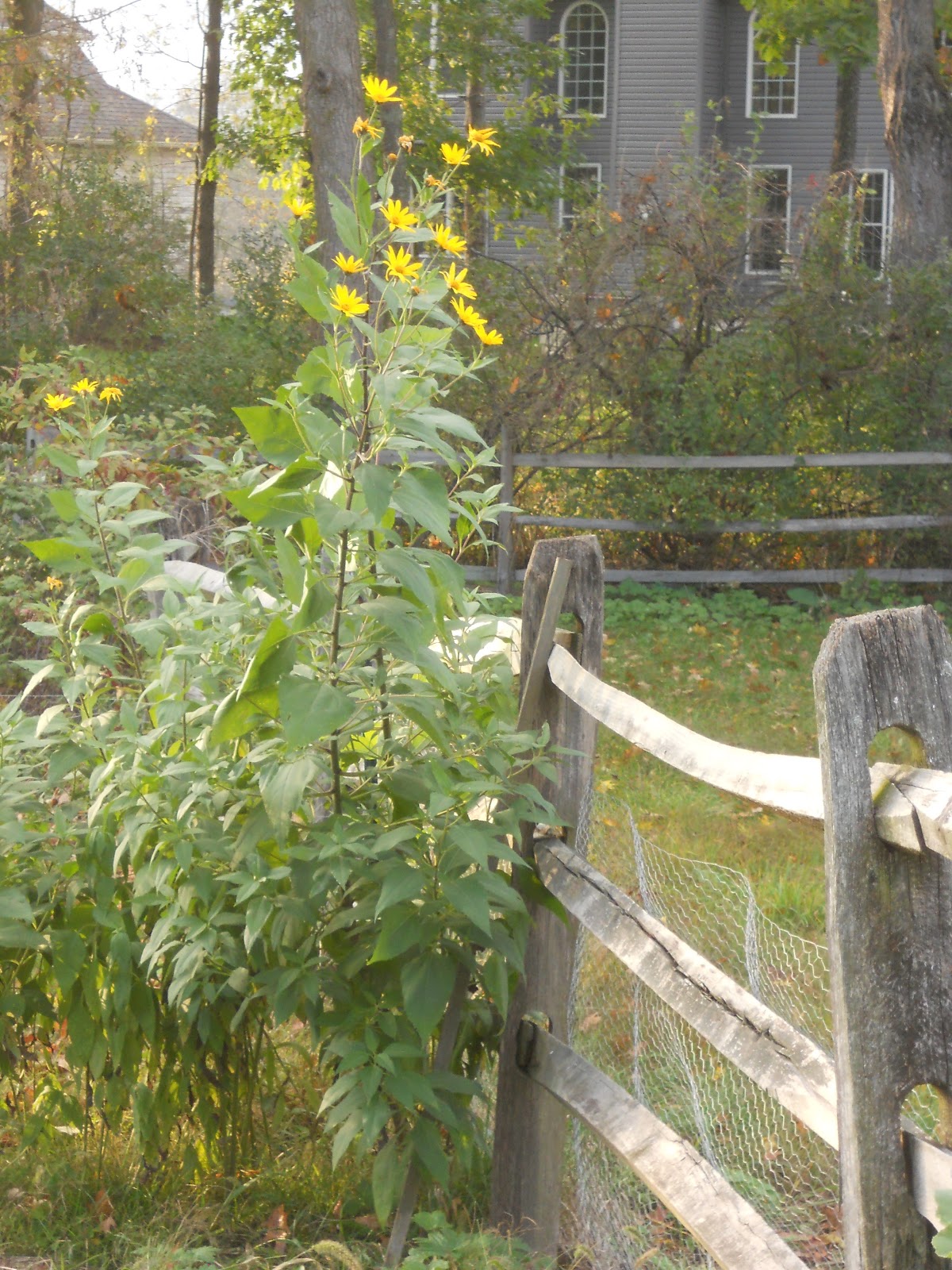
It’s on the other side of town, so it is a special treat, not a weekly haunt. I was scanning the produce section when I spotted a plastic-wrapped package of Jerusalem artichokes. It took all of two seconds for it to end up in my shopping cart. It wasn’t my stomach that was growling, it was a flashback of the Fleur-de-Lys sign at the corner of Hottenstein and Eagle Point, framed by the yellow fireworks of Jerusalem artichokes in bloom.

I bought my first Jerusalem artichoke tubers from the Maine Potato Lady catalog, official purveyor of organic seed potatoes, shallots, and Jerusalem artichokes. It was a leap of faith that I bought these supermarket bound-for-the-kitchen, who-knows-how-long-they’ve-been-sitting-around tubers, but, what the heck.

When I got home, I pulled out a shovel, dug several holes at the far end of the vegetable garden path, dropped each of the tubers in, covered them up with soil, and forgot about them.

Glorious Neck Pumpkin
Also last fall, on my routine Saturday morning Amish market run, I bought a tan neck pumpkin. It was getting to be pumpkin pie time, and Kutztown folk wisdom insists that “neck punkins” make the best pie. Kin to the butternut squash, neck pumpkins are named for their long, curved necks. Unlike your typical jack-‘o-lantern, a shell filled with a slimy webbing and seeds, the bulk of the neck pumpkin is solid, pie-bound flesh. As I chunked up the neck pumpkin for baking in a shallow pan of water, I scooped out a few seeds from the cavity at the base and placed them on a paper towel. I scribbled Neck Pumpkin Seeds on the paper towel, and stashed it in my bedroom – visions of summer dancing in my head.

Well, the 2012 growing season has come and gone with last week’s hard frost and blackening of the basil plants. But before the cold snap hit, I took my camera into the garden to capture two of this year’s success stories.

The lighthouse of this year’s garden was my Wegmans towering Jerusalem artichoke stand, a beacon of beauty, while below sprawling swells of neck pumpkin vines washed over the soil, straw bales, and garden path, cresting as they scaled the split-rail fence. An amazingly strong woman, Mother Nature.

As a final hurrah to the season, I gathered about two teaspoons of lavender blossoms and sprinkled them into the batter of Gateau au Yaourt, and celebrated the growing year with my favorite comfort cake.

Lavender Yogurt Cake

2 eggs
1 cup unsweetened yogurt
1 cup sugar
1/3 cup vegetable oil
2 cups flour
1 ½ tsp. baking powder
½ tsp. baking soda
1 tsp. vanilla
2 tsp. lavender blossoms

Grease the sides of a springform pan and pre-heat oven to 350 degrees. In a large mixing bowl combine eggs, yogurt, sugar, oil, and vanilla. In separate bowl, sift together flour, baking powder and soda. Add flour mixture to yogurt mixture, blending gently. Then sprinkle in lavender blossoms. Pour batter into cake pan and bake for about 35 minutes, or until the top is golden and an inserted knife comes clean. Let cool slightly on a rack, and remove outer ring. Then, indulge. Laurie Lynch

News from Across the Pond: Marina is settling into London, but still has Fleur-de-Lys in her heart, as you can see from her photograph. She swapped the kot and Metro of Brussels for a flat and Tube of London—a whole new language, a whole new world.

On This Side of the Pond: It is garlic-planting time. Rocks are abundant in my new garlic patch, but the bulbs seemed to thrive on the limestone. This year’s planting cloves are huge! 
  
Written on Slate: If you wish to make an apple pie from scratch, you must first invent the universe. –Carl Sagan


Monday, October 1, 2012

Fleur-de-Kalebrity

Red Russian Kale

Back in third grade, when prodded by my teacher, I probably stood in front of the class and said, “My name is Laurie and I like llamas.” When Kristen Beddard was a third grader, she introduced herself with, “My name is Kristen and I like kale.”

And she still likes kale. When the Penn State grad moved to Paris about a year ago, she searched the markets, grocers, and restaurants, and couldn’t find her favorite vegetable! 

Parisian Clotilde Dusoulier also lamented the lack, calling kale “the most elusive ingredient of 2011”. I’ve mentioned Clotilde before. In 2003 she began writing Chocolate & Zucchini e-newsletter (available in English and French), launching her into the cookbook/food-writing world.

What a difference a year and Kristen made.

Kristen started The Kale Project to get French farmers and chefs to embrace kale as a delicious and nutritious vegetable, not just a decorative plant.  On September 20, Verjus restaurant in Paris had a “coming out” party for kale.  Terroirs d ‘Avenir is now distributing kale to Parisian restaurants and green grocers, and Kristen is trying to get a British seed house to supply kale seeds to French growers.

Black Tuscan Kale
It’s not often that we have one over on the French in the culinary scene, so I’m loving this story!  And, as all of you Fleur-de-Lys readers know, I love my kale leaves, whether tossed with potatoes or roasted into Kale Crisps. Autumn is kale season, with frosty nights sweetening the leaves and killing off all those nasty cabbageworms. As always, I have quite the kale forest planted, and this fall I’m going to expand my repertoire and try using the stalks as a braised vegetable. Laurie Lynch

Missing You: I’d love to sit with each of your over a cup of coffee…so I decided on the next-best thing.  I took my camera on my weekend bike ride and respite at Café Lemont, and created this photo essay for you.

Bike & Brew
The beauty across the street


I'd paint the ceiling sky blue


"My" chair and mug


Written on Slate: Barn’s burnt down –
now
I can see the moon.  – Masahide

Borrowed from a wonderful little book called “The Buddha in the Attic” by Julie Otsuka, which was recommended by a reading and walking buddy from Kutztown.

Tuesday, September 4, 2012

Fleur-de-Summer'sEnd


 Pink cosmos, orange marigolds, and crayon-colored zinnias are a gift from my father.

He died three years ago today, after a long illness that kept him out of the garden for several years. But this spring, when I resurrected his raised-bed gardens, I was rewarded with a small patch of volunteers—seedlings of cosmos, marigolds, and zinnias. I carefully weeded the area to allow the upstarts growing room, and voila, as summer comes to a close we have Daddy’s Flower Garden and fresh-cut flowers for the house. Truly a gift from the heavens. Laurie Lynch

Provider from Providence:  When he was living in Providence, RI, nephew Wille gave me a packet of  “Provider” green beans. I planted them this year and love the variety.  Now that I’m an office worker, I don’t get into the garden as often as I’d like. The “Provider” beans got away from me. When I found time to harvest them, they were much larger than I’d normally pick, but I picked them anyway. I tossed them in a little water with a sloshing of Fasta & Ravioli Co. garlic-infused olive oil over high heat…and out came delicious, tender green beans.

Hay-Bale Winner: Although the hay-bale garden was less than a success, I must tell you one plant thrived in the environment: Thelma Sanders’s Sweet Potato squash. This heirloom is an acorn squash with cream-colored skin, and it is slightly larger than the green type. I did a little investigating and read that Thelma vines are sprawling, tough ladies that flourish in dry conditions, wet conditions, hot conditions, and even cooler conditions. In other words, Thelma is idiot-proof and hay-bale-proof.

Rainbow’s Other End: No garden should be without Swiss chard. The rainbow colors of the stalks and leaf veins allow it to dress up an ornamental bed, but I love to eat it. During the Fleur-de-Lys years, I harvested Swiss chard often, keeping the plants dwarfed. This summer, my chard plants are reaching skyward, past my knees. Beautiful, but the vegetable farmer in me wants to use (OK, eat) them. The three of us can only eat so much chard pie and steamed greens.  A thought came to me while I was in the kitchen making German Potato Salad with hot bacon dressing. Why not sauté a few chopped ribs of chard with the onions for the hot bacon dressing? Why not, indeed? The debut of Swiss-German Potato Salad.  

Craving Felt ‘Round the World: I had a craving for smoked salmon this past week. I bought a sliver at the supermarket and was inspired to make a simple pasta dish for dinner: 1 pound of pasta, about ¾ cup of whipped cream cheese, three ounces of smoked salmon, a small handful of home-grown Picasso shallots, and a sprinkling of fresh chopped chives. After cooking the pasta, I drained it and mixed in the cream cheese until the noodles were coated. Then I tossed in small bits of salmon with the chopped shallots and chives. Craving satisfied, and an easy, after-work meal served in minutes, with a side dish of sliced heirloom tomatoes.

As it happened, I mentioned this pasta while Skyping with Marina. She replied that earlier in the week she had the same craving and came up with a similar dish! She tossed cooked pasta with a little cream, cream cheese with herbs, strips of smoked salmon, chunks of cucumber and tomato, and a pinch or two of chopped dill. We laughed at the coincidence, though living on two different continents. If you like smoked salmon, try the mother-version, or the daughter-version, or make up your own!

Written on Slate: “When you are a mother, you are never really alone in your thoughts. A mother always has to think twice, once for herself and once for her child.” –Sophia Loren

Sunday, August 26, 2012

Fleur-de-Atmosphere


Richard and I had to make a daytrip to NYC on business, so to speak, so I decided we needed a little pleasure while we were there. I emailed my nephew Wille, culinary nutrition grad from Johnson & Wales and no stranger to this blog, and asked him to make lunch reservations at the restaurant where he’s been working for the past year, Rouge Tomate.

We met Wille in Bryant Park and wove our way through the crowded sidewalks of Fifth Avenue. The cacophony of Manhattan in full summer flower assaulted the senses: the launching of Maria Sharapova’s SugarPova gummy candies, too much scent wafting out of Abercrombie & Fitch, and the sketchy knowledge that just hours before gunshots echoed in front of the Empire State Building, with many injured.

All of that slid into oblivion as we sat at our table enveloped in the tranquil beige décor of Rouge Tomate. “The Deal” at the restaurant, Wille told us, is the prix fixe menu where, for $29, you get to choose one selection from each category: Appetizer, Entrée and Dessert.

We decided to skip the cocktail menu—Wille was scheduled to work the evening shift, Richard is underage, and I had a five-hour drive ahead of me. Tap water was fine. But that’s not what the manager thought.

She brought three of her favorite fruit juice drinks for us to try “on the house”. We couldn’t argue with her.  One was a concoction of cucumber and watermelon, the second was passionfruit, yerba mate, and something else, and the third, lavender and honeydew melon. These were not heavy juices, more the essence of juice with lots of ice chips for ultimate refreshment.

For our starter we chose Long Island Fluke Ceviche dressed with cubes of honeydew melon, chameh (Korean melon), cucumber, and wisps of kaffir lime and mint, served on long, thin baguette-like plates. Accompanying this was crusty bread with garlic infused olive oil. The dishes were cleared.

Then I heard four of the finest restaurant words in the English language: “Complements of the chef,” as our waiter placed bowls of Cow’s Milk Ricotta Gnudi in front of us. “Gnudi” are basically gnocchi with ricotta cheese replacing the potatoes, making a light dumpling that is boiled and then seared in olive oil and placed in a nest of roasted tomatoes, okra, sweet peppers, summer squash and basil. The chef came to our table to see how we liked the surprise, and I honestly told him that one dish was worth the five-hour trip!

Next came our entrees. Wille chose Whole Brook Trout a la Planche (with quinoa, beans, sweet corn and a tomato-peach salsa). For me, it was Long Island Duck Breast (with plum, ginger, horseradish potato, Japanese eggplant, and a honey-tamari glaze) and Richard went a la carte with Maine Lobster Salad on a bed of endive and tossed with avocado, beans, peaches, pecans and ginger-peach vinaigrette.  We shared bites.

Another on-the-house round of juices, with all of us going with our favorite, the cucumber-watermelon. I’m sure it had an exotic name, but I wasn’t taking notes at the time, I was simply enjoying.

Wille had to report to the kitchen, so Richard and I were left to fend for ourselves during dessert, with plum cake and peach cobbler on the way. But when the waiter brought the plates, there was a third…and those wonderful words, “Complements of the chef.”

Do you remember the first time you saw an onion volcano or choo-choo at a Hibachi steak house, the thrill of a little flame, puff of steam, and edible entertainment? Well, multiply that tenfold, throw in chocolate, lots of chocolate, and you’ve got the Chocolate Atmosphere.

In the middle of a white plate is a chocolate sphere, the size and sheen of a billiard ball, sitting on a low cake throne. The dessert assistant, who is 6foot-5, towers over us with a tiny pitcher. He explains that it is filled with “hot chocolate”.  He pours the hot chocolate over the sphere, which erupts and melts, spilling treasures: black pearls of “compressed banana seeds”, medallions of bananas, and nuggets of chocolate. Richard and I look on in amazement. Then we pick up our spoons. Mmmmm, we were catapulted out of this world and into Chocolate Atmosphere. Laurie Lynch

Encore: We dawdled, finishing the last of our coffee and tea, waiting for the check. Then our waiter appeared and said,  “Didn’t he tell you? Wille took care of the bill. And I was crowned Queen for a NYC Day.

Two RTs: Rouge Tomate (USA) is at 10 E. 60th Street, NYC. The first and only other Rouge Tomate is in Brussels, BE.

Latin Class: Rouge Tomate applies the principals of SPE, inspired by the Latin phrase Santias Per Escam, “health through food”. Founded in 2001, SPE is a holistic approach that focuses on health as well as gastronomic pleasure. Rouge Tomate’s executive chef and pastry chef collaborate with the restaurant’s culinary nutritionist to enhance the nutritional quality of meals without compromising taste. The restaurant supports local farms, fisheries and producers with an emphasis on freshness and seasonality, using whole grains, fruits, vegetables, quality protein and healthy fats.

Bon Appetit: A week before our visit to Rouge Tomate Wille told me the restaurant was featured in the September issue of Bon Appetit.  I bought a copy and tried out the recipe for Corn Farrotto (a butter-free take on risotto), a perfect August dish.

Corn Farrotto
(Serves 4)

Corn Puree

1½ c. fresh corn kernels
½ c. minced onions
1 Tbsp. olive oil
Fine sea salt
2 c. (or more) vegetable broth

Farrotto

2 c. (or more) vegetable broth
1 c. whole-grain farro
Fine sea salt
3 Tbsp. olive oil
½ c. minced red onion
1/3 c. ¼-inch cubes red or yellow bell pepper
1 c. fresh corn kernels
¾ c. grated Parmesan cheese
Freshly ground black pepper
½ c. chopped tomato
2 Tbsp. chopped fresh basil

Corn Puree: Combine corn, onion, oil and pinch of salt in medium saucepan. Cook over low heat, stirring occasionally until onion is softened and translucent, 6-7 minutes (do not brown). Add 2 cups broth, increase heat to high, and bring to a boil. Reduce heat to medium-low and simmer gently, uncovered, until corn is softened and cooked through and liquid is reduced by half, 20-25 minutes. Let cool slightly. Transfer mixture to blender and puree until smooth (when pureeing hot liquids, start with the lid slightly ajar to release steam; cover with a kitchen towel to catch any splatters).

Strain puree through a sieve into a 2-cup heat-proof measuring cup. Add more broth, if needed, to measure 1½ cups. Set aside.

Farrotto: Bring 2 cups broth, farro, a pinch of salt, and 1cup water to simmer in large saucepan. Cook until farro is tender, 30-45 minutes. Drain and return to pot

Meanwhile, heat oil in large skillet over medium heat. Add onion and cook until just beginning to soften, about 3 minutes. Add bell pepper and corn and cook, stirring occasionally, until vegetables begin to brown, about 5 minutes longer; keep warm.

Add corn puree to farro and cook over medium heat, stirring occasionally and adding more broth by ¼-cupfuls if dry, until farro is creamy, 5-6 minutes. Stir in cheese. Season with salt and pepper.

Stir tomatoes and basil into vegetables.

Divide farrotto among bowls. Top with vegetable mixture, dividing equally. Serve immediately.

Closer to Home: Seeds planted in my garden this week: arugula, China Jade baby bok choy, mesclun mix, and Matador spinach (for next spring).

Written on Slate: “The world is full of a number of things, I’m sure we should all be as happy as kings (and queens).” – Mostly Robert Louis Stevenson

Friday, August 17, 2012

Fleur-de-BeCalm


Chalk it up to motherly instincts. I was browsing in a favorite State College shop, Nittany Quill, which features cards, notepaper, and sealing wax for that almost-lost art of letter writing. The Union Jack graphic caught my eye. The words spoke to my heart: Keep Calm and Carry On.

In the midst of writing her senior thesis, Marina was applying to a number of grad schools in Great Britain. The Keep Calm slogan couldn’t be more apt. So I sent her a care package with a Keep Calm and Carry On journal, a couple plastic jars of bubbles and glow-in-the-dark baubles from the Dollar Store, and a few other odds and ends to help her and her friends de-stress during the months before graduation.

The thesis was written, the graduation happened, and Marina was accepted to the University of London’s School of Oriental and African Studies. Turns out that was the easy part. The difficulty has been in these last two months applying for a student visa through the United Kingdom Border Agency.  She is a U.S. citizen living and working in Brussels, Belgium, and wants to study in the UK…ah, there’s the rub!

We are finding the Brits are masters of bureaucracy, with a hefty dose of verification, documentation, and notarization. Look out 007.

I had to Express Mail a packet containing Marina’s original birth certificate (which cannot be copied according to our government) to prove that I am indeed her mother, along with various bank documents indicating that as her mother I have enough in my accounts to assure she won’t be penniless (or poundless) in London.

Her father had to search through her dresser and desk drawers at 440 Hottenstein to find her expired passport and overnight it to Brussels.

Marina is living in Brussels, headquarters of the European Union, and she can’t get the necessary biometric scans of her face and fingers now required by UK of GB’s homeland security. (We did take a moment to laugh that this biometric verification technology sounds like something out of our favorite TV show from years ago, Alias.) Even the U.S. Embassy in Brussels couldn’t help. Our embassy only helps replace lost or stolen passports and visas, but does not help our citizens apply for them. “That is a matter between you and the British authorities.”

The hoops to jump through were intense. Would she really need to make a trip back to the U.S. just to get her visa to study in the UK, just a hop, skip and Chunnel ride away?

Well, as it turns out, she could also get the biometric scans in Paris. So, the other morning she boarded the Thalys in Brussels, zoomed to Paris for the scans, a haircut, and lunch at the foot of Montmartre, and was back in Brussels to put in a few hours at the office, and then meet friends for the opening of the Flower Carpet and fireworks at the Grand-Place. The moral of the story: When life gives you lemons, head to Paris for a great haircut? Laurie Lynch

Great Brit-History: In 1939, the government of the United Kingdom printed Keep Calm and Carry On posters to raise citizen morale in case of invasion.  Distribution of the poster was limited, and it wasn’t until 2000 that one was rediscovered in a second-hand bookstore, and re-issued by several private companies.

Roll out the Carpet: Every two years in Brussels’ major square, the Grand-Place, 650,000 to 750,000 begonia blossoms are woven into a magical carpet measuring 77 x 24 meters. This year’s carpet honors Africa.

Begonias, native to the West Indies, have been grown in Ghent since 1860. Surprisingly, at least to me, the tiny country of Belgium is the world’s largest producer of begonia tubers. The Flower Carpet floral masterpiece is ephemeral, lasting only five days. Marina visited for the opening ceremony Tuesday night and again today, and took the photos for this blog.

Yet to Come: The visa is in the processing stage…and Marina still has to find an apartment in London. Keep Calm. Keep Calm. Keep Calm.

Written on Slate: “I am the terror that flaps in the night, I am the slug that slimes your begonias.” –Darkwing Duck

Monday, August 6, 2012

Fleur-de-Anthem


Goosebumps, chills, tears flooding the corners of my eyes, I’m suffering from Olympic fever. And oh, when they play the national anthem, look out!

This isn’t just a gold medal affair scheduled every two years. Weeks before the opening ceremony in London the same symptoms arose during a Skype call with Marina.

Marina and her friends organized a barbeque in the courtyard behind her kot (a four-story residence with communal kitchen, toilet, and shower, and individual bedrooms).  Everyone brought a dish to share and the grill turned out a serious supply of sausages. Yes, there was plenty of Belgian beer to wash it all down. It was also one fellow’s birthday. As the night wore on, the group sang Happy Birthday—in English, Flemish, French, Norwegian, and Portuguese. Then began the round robin of national/regional anthems (the Belgians in attendance knew the Flemish words to the Limburg province song but not the country’s national lyrics). Listening to the play-by-play reporting of the spontaneous, though probably off-key, performances warmed my heart, as global goosebumps, multi-cultural chills, and world peace tears rolled down my cheeks. Laurie Lynch

Small World News: This international gathering included not one but TWO Kutztown High School grads. Elsa Voytas, a student at William and Mary, spent the summer in Brussels as a NATO intern. Marina, a summer intern at Rand Corporation in Brussels, was glad their stays overlapped.

Behind the Olympic Rings: I heard a wonderful story from a friend of the family in State College. I thought I’d share it with all of you parents and teachers out there. We all probably spend a lot more time than we should worrying about the futures of our teen-agers/young adults. Yes, they need guidance and mentorship, but we’ve got to remember there are lots of paths to take.

S. Paul Mazza’s son David didn’t like high school and didn’t want to go to college. This wasn’t easy for Paul, a Harvard Law School grad, to understand. In high school a Vo-Tech teacher took an interest in David and channeled his interests into helping with audio-visual equipment at school. David enrolled at Penn State, but calculus ended his college career after one term. So he started doing freelance work. One of his first jobs was lugging cables from the TV trailers into Beaver Stadium when the network camera crews came to Penn State for football games. From those humble beginnings, David today is engineer-in-chief for NBC’s Olympic coverage in London. His younger brother Paul is monitoring the Olympic transmissions at the New York office. Among other things, David created the systems for moving and setting up NBC’s electronic equipment from Atlanta to Nagano, Sydney to Salt Lake City, Athens, Torino, Beijing and Vancouver. Instead of a college degree, David has a collection of more than a dozen Emmys for his work. Read more on David Mazza at:

Where's Waldo Watermelon?
Hay Bale Update:  A droughty summer is not the time to grow in hay/straw bales. They take an inordinate amount of water, so if Mother Nature isn’t providing, who has the time, or water, for that matter? Most transplants withered and died. The watermelon fruited, but the melon could fit inside a thimble. The eggplants are, as usual, riddled with flea beetles and haven’t flowered. The peppers droop, but then spring back to life after watering and have born meager fruit. The zucchini looks robust, but I’m not holding my breath for a bumper crop. Although bale gardening might work with gardeners with physical limitations (either their own or their planting area), I won’t try it again…but it did help me kill grass for a new, in-ground, raised-bed garden next year.

Written on Slate: “I remember standing on that podium, …and for the first time probably before or since, wishing our national anthem had more verses.” –Dan Jansen

Sunday, July 29, 2012

Fleur-de-Found


I cried our first night in Treviso.

Richard spent a romantic evening in Venice and didn’t want to leave.  It took me five embarrassing and frustrating minutes to find reverse on the rental car. The GPS that Nicola arranged fell through. I was the ire of a sleep-deprived 20 year old.

With Richard checked into the Treviso hotel, Marina and I tried to navigate streets without signposts (street names are hidden on buildings) from the hotel to the Treviso information center. We took a 30-minute detour around the city, hopelessly lost. A sweet Italian who knew as much English as we knew Italian went out of his way to get us to an “internet café”—common ground. From there, the tourism office helped us find a phone number for my father’s cousin, Settimio, with whom we had had one initial email correspondence.  In that email (written in English by a translator), Settimio said  that he was 86 and had been blind for 10 years. But still, he welcomed us.

It was a mistake to come on a hope and a prayer and an international driver’s license believing I could manage a foreign car on foreign soil. What was I thinking? Was I thinking?  I cried over pizza (prosciutto and arugula) as Marina and I sat in a restaurant.  In the midst of an emotional meltdown I came up for air. Was there was a way to salvage the trip? Figure this out.

We needed to do two things: 1. Contact Settimio. 2. Get GPS. The rest, I believed, would fall into place.

Settimio on his newest toy
Our Italian translator sound asleep, we asked the hotel clerk to call Settimio. After some confusion and three or four calls, we made arrangements to go to his home the following day. The clerk also called the airport, once again reserving our much-needed GPS.

A new day.  Marina helped me find the airport. We got our GPS! We returned to the hotel to pick up Richard, one conquest under our seatbelts. We plugged in the address. Hey, this is easy! Settimio and his son Luca greeted us at the front door. In minutes we were touring Settimio’s garden. The house was surrounded with fruit trees—persimmon, cherry, apricot—all used as supports for his tomato plants And there were basil, zucchini, cabbage, pepper, eggplant and bean plants.  And fig trees, glorious fig trees! I had come looking for our roots in Italy, and found them in a Treviso garden.

Where’s your garlic? I asked Settimio through Richard. Though sightless, Setimio knew his way around his garden. “He doesn’t grow garlic,” Richard interpreted for me. “He doesn’t like garlic.” My Italian relative doesn’t like garlic? Talk about a shattered image.

Luca slicing prosciutto 
With Richard’s Italian and Luca’s English we pieced together a lively conversation with Settimio, wife Ilda, and sons Luca and Marco. Settimio and his family visited my parents in State College in 1985. Apparently the highlight of the trip was riding in my parents’ 8-person van! Settimio spent 35 years working for Barilla, an Italian pasta company whose products are sold these days in our neighborhood Weis supermarket.

In the heart of his home, Settimio has a room lined with racks of wine he bottles himself and a hand-cranked prosciutto slicer. Then he led us to the dining room, where we gorged on prosciutto sliced as thin as ribbons, marinated mushrooms, pasta, pork, vegetables, a different wine with each course, and finally, as if we had any room, chocolate cake and grappa with espresso. We finished the afternoon with Luca taking us on a tour of the Palladian villas built by Venetian nobility and a stroll through the streets and piazzas of Treviso. This ancient city is encircled by stonewalls and crisscrossed with Sile River canals and bridges.

Abele's birthplace
(Quick and condensed history lesson: The Veneto, which includes Venice, Treviso, and much of northeast Italy all the way to Austria, is one of 20 regions in Italy. It was part of the Roman Empire, invaded by the likes of Atilla the Hun, and then reigned as the Republic of Venice from the Middle Ages through the Renaissance. In 1797 Napoleon dissolved the Republic and ceded the Veneto to the Austrian Empire. In fact, it wasn’t until 1866, after our Civil War, that the Veneto joined Italy.)

The following day we picked up Settimio in our rental car for him to escort us to my grandfather’s birthplace, Fregona, about 30 miles north.  So, with an 86-year-old blind man giving directions in Italian, Richard translating them, and the Brit on GPS as backup, we drove past vineyards and villas through the Veneto countryside.  Fregona is nestled in the backbone of the Pre-Alps, and roads are steep, narrow, and zigzagged.  Near the top of the village was the house where my grandfather, Abele, and Settimio’s mother, Adele, were born. After a brief stop for photos, we continued our journey.

Cansiglio Plateau
Settimio warned me to drive slowly as we approached the first of seven hairpin turns up the mountain behind Fregona entering the Cansiglio woods. The trees of this beech forest were carved into giant oars for rowing the battle ships of the Venetian Republic. My great-grandfather, Settimio told us, used that same beech for his livelihood, making thin, round boxes for the local cheeses. The forest is also home to the Calieron caves, where Italian resistance fighters hid as they sabotaged German troops.

Village Chapel


Up  up we climbed to a lookout where, on a clear day, you can see Venice. We continued driving up over the “crown” of the Pre-Alps and dropped into the hollow of the Cansiglio Plateau. The rural beauty took my breath. Sheep grazing in green pastures. A dairy filled with homemade yogurt in glass jars, fruit strudels, cheesecakes, and wheels of local cheese. A visit with Settimio’s eldest son, Adecchi, at his weekend home in a tiny village in the Cansiglio.  I knew there was a reason  that when I climbed Fleur-de-Lys’ hen hill I broke into song: “The hills are alive, with the sound of music…” My Italian roots have branches that reach into the alpine hills, my heritage.

We had worked up quite an appetite. Settimio took us to a restaurant where he was greeted like family. He guided us through the menu, selecting a platter of “funghi” (mushrooms, like the ones he gathered in the woods in his younger days), gnocchi with speck (juniper-flavored ham) and more funghi, cherries served in a bowl of ice water, and “red deer” in a rich sauce spooned alongside three peaks of golden polenta…just like my grandmother used to make.

At last, yellow polenta. And the waitress spoke English! I asked her why every restaurant in Venice served white polenta, but her restaurant served yellow. The bianca, she said, is refined, like the Venetians; the yellow polenta is the food of peasants. Like me.  Cincin! Laurie Lynch

Translation: Cincin (pronounced cheen-cheen) is “Cheers” in Italian.

Fregona cemetery, Settimio's parents Adele and Roberto buried
Background: My grandfather Abele Fedon was one of 3 million people who left Northern Italy to escape poverty between 1861 and 1961. He settled in Pen Argyl, Northampton County, PA, where he worked as a cobbler. It wasn’t until this trip that I realized his nickname, which I had only heard spoken, was “Bele,” the diminutive of Abele, not the word “belly,” for his ample one.

More Background: I knew my grandmother, Nives Marcon Fedon, was born in Danielsville, Northampton County, PA, but that her older siblings were born in Italy. I did a little digging after we returned and found that her older sister Dolores was born in Colle Umberto, just four miles south of Fregona. Nives’ parents were living when my older cousin was born, so the Nonno and Nonna names were already in use. He called his grandmother Nives “Nene, “ and it stuck. Her sister Dolores became “Dodo.”  Family gatherings were quite a hoot: Nene, Nonno, Dodo, Nonna. Sheesh!

Looking Forward: Settimio and Ilda also have a daughter, Donatella, who I met via the telephone while visiting Italy. Donatella has a daughter Kendra who is living in Cambridge, England. Marina and Kendra plan to get together this fall when Marina starts her Master’s degree at the University of London’s School of Oriental and Asian Studies.

The Recipe: I can still picture Nene, with both arms, stirring a kettle of polenta on the stove. For hours, she’d go round and round with an 18-inch long wooden paddle as the cornmeal belched steaming bubbles and thickened until the wooden paddle stood upright on its own.

Luckily, years ago my mother (of Polish heritage, mind you) found an easier way of making polenta. It’s the one I use, and I’ve often doubled the recipe without any problems:

Golden Polenta

1-½ cups yellow cornmeal
1-½ cups water
1 teaspoon salt
2 cups boiling water
2 tablespoons butter

In saucepan stir together cornmeal, 1-½ cups of water, and salt. Gradually pour in 2 cups boiling water, stirring constantly. Bring mixture to boil. Partially cover pan and cook over low heat for 7 to 10 minutes, stirring often. When the wooden spoon stands up straight in thickened polenta, stir in butter and serve.

Nene always served polenta smothered in “tocio” (which sounds like tocho). Luca tells me “tocio” is Venetian for “sauce”. The basics of my favorite Nene sauce are first sautéing chopped onions in olive oil, then adding chicken breasts sprinkled with hefty amounts of cinnamon to brown. Once both sides are browned, add tomatoes, tomato paste, and herbs. This cooks long and slow until the meat can be gently pulled from the bone.