Mount Nittany Sunrise.

Monday, August 6, 2012

Fleur-de-Anthem


Goosebumps, chills, tears flooding the corners of my eyes, I’m suffering from Olympic fever. And oh, when they play the national anthem, look out!

This isn’t just a gold medal affair scheduled every two years. Weeks before the opening ceremony in London the same symptoms arose during a Skype call with Marina.

Marina and her friends organized a barbeque in the courtyard behind her kot (a four-story residence with communal kitchen, toilet, and shower, and individual bedrooms).  Everyone brought a dish to share and the grill turned out a serious supply of sausages. Yes, there was plenty of Belgian beer to wash it all down. It was also one fellow’s birthday. As the night wore on, the group sang Happy Birthday—in English, Flemish, French, Norwegian, and Portuguese. Then began the round robin of national/regional anthems (the Belgians in attendance knew the Flemish words to the Limburg province song but not the country’s national lyrics). Listening to the play-by-play reporting of the spontaneous, though probably off-key, performances warmed my heart, as global goosebumps, multi-cultural chills, and world peace tears rolled down my cheeks. Laurie Lynch

Small World News: This international gathering included not one but TWO Kutztown High School grads. Elsa Voytas, a student at William and Mary, spent the summer in Brussels as a NATO intern. Marina, a summer intern at Rand Corporation in Brussels, was glad their stays overlapped.

Behind the Olympic Rings: I heard a wonderful story from a friend of the family in State College. I thought I’d share it with all of you parents and teachers out there. We all probably spend a lot more time than we should worrying about the futures of our teen-agers/young adults. Yes, they need guidance and mentorship, but we’ve got to remember there are lots of paths to take.

S. Paul Mazza’s son David didn’t like high school and didn’t want to go to college. This wasn’t easy for Paul, a Harvard Law School grad, to understand. In high school a Vo-Tech teacher took an interest in David and channeled his interests into helping with audio-visual equipment at school. David enrolled at Penn State, but calculus ended his college career after one term. So he started doing freelance work. One of his first jobs was lugging cables from the TV trailers into Beaver Stadium when the network camera crews came to Penn State for football games. From those humble beginnings, David today is engineer-in-chief for NBC’s Olympic coverage in London. His younger brother Paul is monitoring the Olympic transmissions at the New York office. Among other things, David created the systems for moving and setting up NBC’s electronic equipment from Atlanta to Nagano, Sydney to Salt Lake City, Athens, Torino, Beijing and Vancouver. Instead of a college degree, David has a collection of more than a dozen Emmys for his work. Read more on David Mazza at:

Where's Waldo Watermelon?
Hay Bale Update:  A droughty summer is not the time to grow in hay/straw bales. They take an inordinate amount of water, so if Mother Nature isn’t providing, who has the time, or water, for that matter? Most transplants withered and died. The watermelon fruited, but the melon could fit inside a thimble. The eggplants are, as usual, riddled with flea beetles and haven’t flowered. The peppers droop, but then spring back to life after watering and have born meager fruit. The zucchini looks robust, but I’m not holding my breath for a bumper crop. Although bale gardening might work with gardeners with physical limitations (either their own or their planting area), I won’t try it again…but it did help me kill grass for a new, in-ground, raised-bed garden next year.

Written on Slate: “I remember standing on that podium, …and for the first time probably before or since, wishing our national anthem had more verses.” –Dan Jansen

Sunday, July 29, 2012

Fleur-de-Found


I cried our first night in Treviso.

Richard spent a romantic evening in Venice and didn’t want to leave.  It took me five embarrassing and frustrating minutes to find reverse on the rental car. The GPS that Nicola arranged fell through. I was the ire of a sleep-deprived 20 year old.

With Richard checked into the Treviso hotel, Marina and I tried to navigate streets without signposts (street names are hidden on buildings) from the hotel to the Treviso information center. We took a 30-minute detour around the city, hopelessly lost. A sweet Italian who knew as much English as we knew Italian went out of his way to get us to an “internet café”—common ground. From there, the tourism office helped us find a phone number for my father’s cousin, Settimio, with whom we had had one initial email correspondence.  In that email (written in English by a translator), Settimio said  that he was 86 and had been blind for 10 years. But still, he welcomed us.

It was a mistake to come on a hope and a prayer and an international driver’s license believing I could manage a foreign car on foreign soil. What was I thinking? Was I thinking?  I cried over pizza (prosciutto and arugula) as Marina and I sat in a restaurant.  In the midst of an emotional meltdown I came up for air. Was there was a way to salvage the trip? Figure this out.

We needed to do two things: 1. Contact Settimio. 2. Get GPS. The rest, I believed, would fall into place.

Settimio on his newest toy
Our Italian translator sound asleep, we asked the hotel clerk to call Settimio. After some confusion and three or four calls, we made arrangements to go to his home the following day. The clerk also called the airport, once again reserving our much-needed GPS.

A new day.  Marina helped me find the airport. We got our GPS! We returned to the hotel to pick up Richard, one conquest under our seatbelts. We plugged in the address. Hey, this is easy! Settimio and his son Luca greeted us at the front door. In minutes we were touring Settimio’s garden. The house was surrounded with fruit trees—persimmon, cherry, apricot—all used as supports for his tomato plants And there were basil, zucchini, cabbage, pepper, eggplant and bean plants.  And fig trees, glorious fig trees! I had come looking for our roots in Italy, and found them in a Treviso garden.

Where’s your garlic? I asked Settimio through Richard. Though sightless, Setimio knew his way around his garden. “He doesn’t grow garlic,” Richard interpreted for me. “He doesn’t like garlic.” My Italian relative doesn’t like garlic? Talk about a shattered image.

Luca slicing prosciutto 
With Richard’s Italian and Luca’s English we pieced together a lively conversation with Settimio, wife Ilda, and sons Luca and Marco. Settimio and his family visited my parents in State College in 1985. Apparently the highlight of the trip was riding in my parents’ 8-person van! Settimio spent 35 years working for Barilla, an Italian pasta company whose products are sold these days in our neighborhood Weis supermarket.

In the heart of his home, Settimio has a room lined with racks of wine he bottles himself and a hand-cranked prosciutto slicer. Then he led us to the dining room, where we gorged on prosciutto sliced as thin as ribbons, marinated mushrooms, pasta, pork, vegetables, a different wine with each course, and finally, as if we had any room, chocolate cake and grappa with espresso. We finished the afternoon with Luca taking us on a tour of the Palladian villas built by Venetian nobility and a stroll through the streets and piazzas of Treviso. This ancient city is encircled by stonewalls and crisscrossed with Sile River canals and bridges.

Abele's birthplace
(Quick and condensed history lesson: The Veneto, which includes Venice, Treviso, and much of northeast Italy all the way to Austria, is one of 20 regions in Italy. It was part of the Roman Empire, invaded by the likes of Atilla the Hun, and then reigned as the Republic of Venice from the Middle Ages through the Renaissance. In 1797 Napoleon dissolved the Republic and ceded the Veneto to the Austrian Empire. In fact, it wasn’t until 1866, after our Civil War, that the Veneto joined Italy.)

The following day we picked up Settimio in our rental car for him to escort us to my grandfather’s birthplace, Fregona, about 30 miles north.  So, with an 86-year-old blind man giving directions in Italian, Richard translating them, and the Brit on GPS as backup, we drove past vineyards and villas through the Veneto countryside.  Fregona is nestled in the backbone of the Pre-Alps, and roads are steep, narrow, and zigzagged.  Near the top of the village was the house where my grandfather, Abele, and Settimio’s mother, Adele, were born. After a brief stop for photos, we continued our journey.

Cansiglio Plateau
Settimio warned me to drive slowly as we approached the first of seven hairpin turns up the mountain behind Fregona entering the Cansiglio woods. The trees of this beech forest were carved into giant oars for rowing the battle ships of the Venetian Republic. My great-grandfather, Settimio told us, used that same beech for his livelihood, making thin, round boxes for the local cheeses. The forest is also home to the Calieron caves, where Italian resistance fighters hid as they sabotaged German troops.

Village Chapel


Up  up we climbed to a lookout where, on a clear day, you can see Venice. We continued driving up over the “crown” of the Pre-Alps and dropped into the hollow of the Cansiglio Plateau. The rural beauty took my breath. Sheep grazing in green pastures. A dairy filled with homemade yogurt in glass jars, fruit strudels, cheesecakes, and wheels of local cheese. A visit with Settimio’s eldest son, Adecchi, at his weekend home in a tiny village in the Cansiglio.  I knew there was a reason  that when I climbed Fleur-de-Lys’ hen hill I broke into song: “The hills are alive, with the sound of music…” My Italian roots have branches that reach into the alpine hills, my heritage.

We had worked up quite an appetite. Settimio took us to a restaurant where he was greeted like family. He guided us through the menu, selecting a platter of “funghi” (mushrooms, like the ones he gathered in the woods in his younger days), gnocchi with speck (juniper-flavored ham) and more funghi, cherries served in a bowl of ice water, and “red deer” in a rich sauce spooned alongside three peaks of golden polenta…just like my grandmother used to make.

At last, yellow polenta. And the waitress spoke English! I asked her why every restaurant in Venice served white polenta, but her restaurant served yellow. The bianca, she said, is refined, like the Venetians; the yellow polenta is the food of peasants. Like me.  Cincin! Laurie Lynch

Translation: Cincin (pronounced cheen-cheen) is “Cheers” in Italian.

Fregona cemetery, Settimio's parents Adele and Roberto buried
Background: My grandfather Abele Fedon was one of 3 million people who left Northern Italy to escape poverty between 1861 and 1961. He settled in Pen Argyl, Northampton County, PA, where he worked as a cobbler. It wasn’t until this trip that I realized his nickname, which I had only heard spoken, was “Bele,” the diminutive of Abele, not the word “belly,” for his ample one.

More Background: I knew my grandmother, Nives Marcon Fedon, was born in Danielsville, Northampton County, PA, but that her older siblings were born in Italy. I did a little digging after we returned and found that her older sister Dolores was born in Colle Umberto, just four miles south of Fregona. Nives’ parents were living when my older cousin was born, so the Nonno and Nonna names were already in use. He called his grandmother Nives “Nene, “ and it stuck. Her sister Dolores became “Dodo.”  Family gatherings were quite a hoot: Nene, Nonno, Dodo, Nonna. Sheesh!

Looking Forward: Settimio and Ilda also have a daughter, Donatella, who I met via the telephone while visiting Italy. Donatella has a daughter Kendra who is living in Cambridge, England. Marina and Kendra plan to get together this fall when Marina starts her Master’s degree at the University of London’s School of Oriental and Asian Studies.

The Recipe: I can still picture Nene, with both arms, stirring a kettle of polenta on the stove. For hours, she’d go round and round with an 18-inch long wooden paddle as the cornmeal belched steaming bubbles and thickened until the wooden paddle stood upright on its own.

Luckily, years ago my mother (of Polish heritage, mind you) found an easier way of making polenta. It’s the one I use, and I’ve often doubled the recipe without any problems:

Golden Polenta

1-½ cups yellow cornmeal
1-½ cups water
1 teaspoon salt
2 cups boiling water
2 tablespoons butter

In saucepan stir together cornmeal, 1-½ cups of water, and salt. Gradually pour in 2 cups boiling water, stirring constantly. Bring mixture to boil. Partially cover pan and cook over low heat for 7 to 10 minutes, stirring often. When the wooden spoon stands up straight in thickened polenta, stir in butter and serve.

Nene always served polenta smothered in “tocio” (which sounds like tocho). Luca tells me “tocio” is Venetian for “sauce”. The basics of my favorite Nene sauce are first sautéing chopped onions in olive oil, then adding chicken breasts sprinkled with hefty amounts of cinnamon to brown. Once both sides are browned, add tomatoes, tomato paste, and herbs. This cooks long and slow until the meat can be gently pulled from the bone.


Wednesday, July 18, 2012

Fleur-de-Venice


 Something is wrong. We’re sitting on the broad Via Garibaldi at Trattoria Giorgione. It’s my first meal in Italy – Polenta e Schie  – and it is all wrong. Tiny gray lagoon shrimp, about the size of the tip of my pinkie, are nestled on a bed of what looks like cream of wheat. This is not my grandmother’s polenta.

Oh, Venice is beautiful. Imagine 117 islands laced with arching bridges, churches and grand homes adorned with frescoes and mosaics, and the burgundy and gold flag of the Most Serene Republic fluttering from iron balconies centuries old. One of the first photos I snap from the vaporetto (water taxi) on the Grand Canal is of the Hotel Marconi. Marcon was my grandmother’s maiden name. And one of the last photos is of the Hotel Bellini—the peachy-rose color of one of my favorite drinks—Bellini, made of prosecco and white peach puree. The ancient walls of Venice come in shades of ochre, cream, rose, mustard, and cinnamon draped in climbing roses, brighten with window boxes of geraniums, or festooned with lines of laundry. Gilt and gargoyles, tile roofs and marble floors, arches and archangels, light and shadow playing on the waterways and alleyways. Pale pink Murano streetlamps and ornate chandeliers sparkle with quiet elegance. We listen as dueling orchestras rally the crowds on the Piazza San Marco. On one street, not far from the Rialto Market, we find a touch of Kutztown in Venice—a sandwich shop decorated in the style of Keith Haring. We watch the ebony gondolas traverse the canal. The bold striped shirts of the gondoliers prompt Richard to remark, “Where’s Waldo?”  

A touch of Keith Haring
As we eat our way through Venice, Richard, Marina and I order antipasto, primo piatto and secondo piatto–and then trade bites, multiplying our tastes threefold: pasta dressed in squid ink, prosciutto-topped pizza, risotto with mushrooms and Asiago, prosciutto with melon, grilled cuttlefish, fried sardines, Insalata Caprese (salad of ripe tomatoes, basil, and fresh buffalo mozzarella drizzled with a fine olive oil). Almost every dish has the same salty, white polenta on the plate. I begin to doubt my culinary heritage.

 I’ve read that the secret to Venetian cooking is simplicity, or, as a Venetian would say, “Non pio di cinque,” Never use more ingredients than you have fingers on your hand. But why was their polenta white and runny, not the rich yellow mounds of cornmeal from my childhood?

We drink our way through Venice with variety, not quantity, the rule. I want to drink a Bellini made in the city that created it, sample the local Valpolicella wine, sip the sweetness of a Sgropino (vodka, prosecco and lemon gelato), and compare the many variations of Spritz (our favorite being prosecco with Aperol, a bitter made from rhubarb, oranges, and medicinal herbs. Is there an Italian saying: A shot of Aperol a day keeps the doctor away?

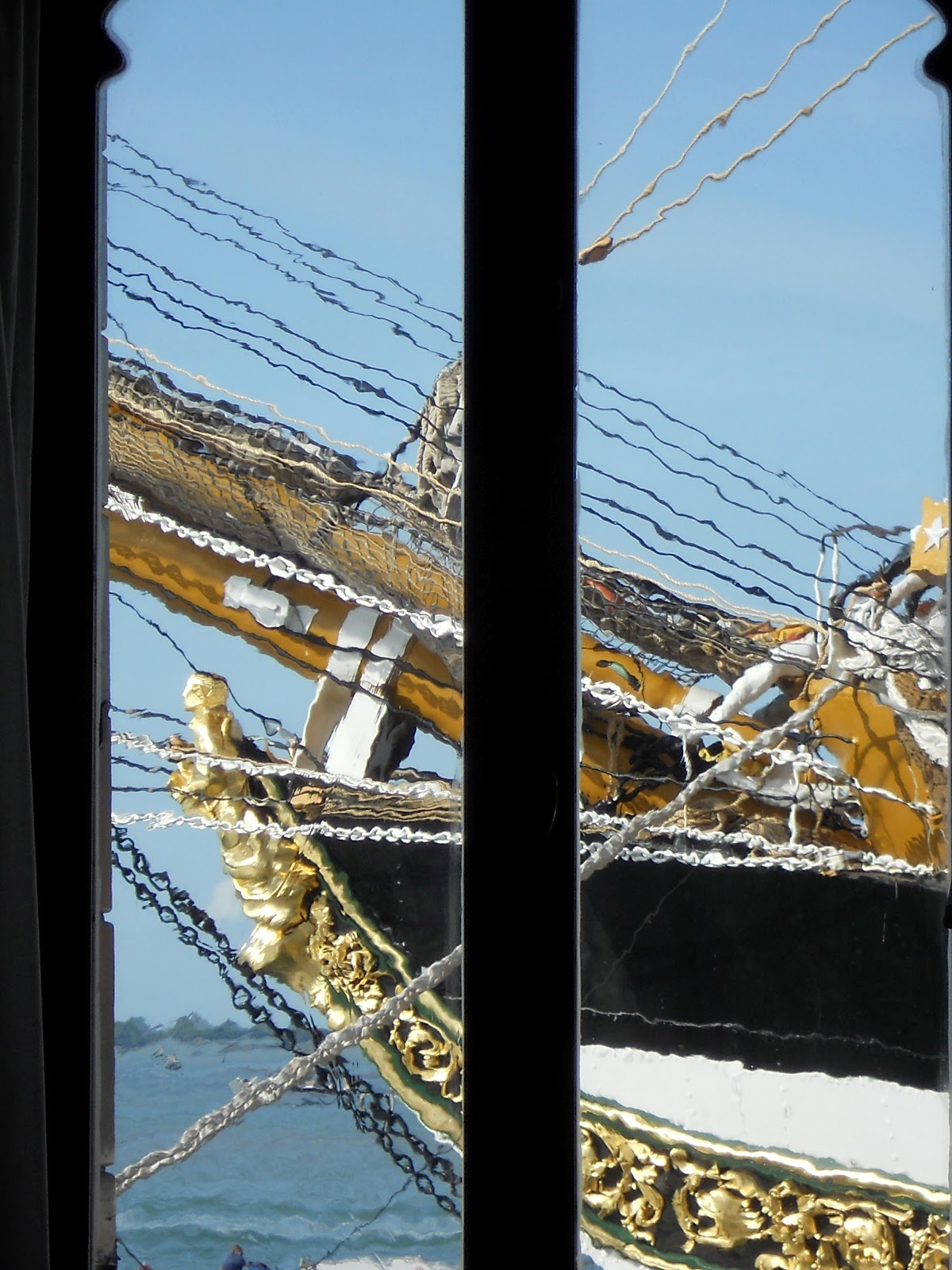
Good fortune via venere.com leads us to Al Tramonto Dorato (The Golden Sunset), a B&B near the Arsenale immortalized by Dante. By staying near the residential section of Venice we are visitors rather than tourists. Our innkeeper, Nicola, takes one look at Richard (all 6-foot-7 of him) and invites  him to play basketball with his Venetian team for that night's game. He also apologizes that the docking of the Italian Navy’s Amerigo Vespucci is blocking our view of San Giorgio Island. Quite the contrary, we enjoy the up-close and personal view of the tall ship and watch in amusement as the boatswain blows his whistle and the crew of 450 midshipmen line up for shore leave.

Marina, Nicola and Richard

When it is time for us to say good-bye to Venice, we tote our bags to the Arsenale vaporetto stop, ride up the canal and then take a bus to Treviso and our rental car. The journey to experience our Italian roots has just begun. I have more questions than answers, and still haven’t solved the mystery of polenta bianca.  Laurie Lynch


Written on Slate: “If I were not the king of France, I would choose to be a citizen of Venice.” – Henry III of France

Elderberry Envy: As we traveled around Belgium, I kept seeing elderberry shrubs and hedgerows in full bloom. Then, on my bike ride into work, I saw an enormous specimen in a Lemont yard. One day while passing, I noticed the homeowner trimming his yews. I braked my bike to a stop and started talking about his elderberry shrub, finally asking if I could come back to pick some flowers for elderblossom cordial.  “Very Scandinavian,” he said, “of course.”

Over the weekend I decided to take a leisurely ride and stop for coffee at Café Lemont. I sat on the curving Victorian porch sipping my Peruvian Norte and watching a hummingbird sip nectar from the flowers in a hanging basket. On the way home, I stopped and picked a bag of elderblossoms for a fresh batch of homemade cordial. Perfect mornings don’t only exist in Venice.


Sunday, July 8, 2012

Fleur-de-Fasta


We interrupt our travelogue series to bring you a not-so-brief news flash.
The ad ran in the July 4 Centre Daily Times newspaper: Grand opening for Fasta & Ravioli Co. July 7 in Pleasant Gap, a small town eight miles from State College: One FREE pound of fettuccini every week for a year to the first 25 customers.
On Thursday, I’m talking to a few of the guys at work about the promotion. Then Anthony, my great uncle’s grandson, gives me a little insider history of the pasta company. His childhood friend Bob majored in Hotel and Restaurant Management at PSU and then worked at the Nittany Lion Inn. One day Bob and Anthony went into Manhattan. Bob kept saying he wanted to check out “Eeeetaly” and Anthony corrected him, saying, “Don’t you mean Little Italy?” Back and forth it went, until they arrived at the storefront Eataly. At Eataly, you can buy all edible things Italian, and, if you bring in a bottle, they’ll fill it up with authentic olive oil or balsamic vinegar. Bob used Eataly as a model for his State College shop, Fasta & Ravioli Co. This weekend, he officially opened his second store offering fresh pasta with local ingredients, as well as oils, vinegars, and other delights. “Fasta” combines the words fresh and pasta—as well as the fact that the fettuccini, for instance, reaches “al dente” stage only three minutes after it is added to boiling water.
I can’t resist.
On Friday I tell Richard my plans. He offers to drive to Pleasant Gap to check things out after his late shift at a State College bar/restaurant. He gets home from his scouting mission around 2 a.m. and reports that the place is empty. “Well, I’m awake. I might as well drive over,” I tell him.
“Lock your doors.” Sounds just like his father.
I get to Fasta at 2:26 a.m. The street is desolate. In the next 20 minutes two vehicles pass by. I stake my territory with a lawn chair next to the front door, get back in the car, and try to nap. Penn State had Paternoville; Pleasant Gap has Fastaville. That Fastaville consists not of dozens of tents but a solitary burgundy Toyota Scion makes little difference. Inside is everything I need: a reclining seat and PSU Creamery insulated bag stuffed with supplies. A few ice packs, water bottle, cantaloupe chunks, multigrain toast spread with cream cheese and topped with smoked almonds, and a bag of Kettle Corn.
It’s 3:05 a.m. The CDT delivery guy fills the vending machine near the Fasta & Ravioli Co. door with Saturday papers.
I’m surprisingly comfortable. I toe my sandals off, doze into a dream, and wake in a nightmare. I lock my keys—and my sandals—in the car. The doors swing wide for the Grand Opening but the sign says, “No Shoes, No Service”.  I’m barefoot and can’t get in for my pasta. Just a nightmare. Then another. What if I have the wrong date?
From 1969 to 1996 my mother owned a gourmet cooking shop called The Country Sampler. At home she had every kitchen gadget and appliance known to woman. I see my parents, shoulder to shoulder, cranking out ribbons of spinach fettuccini, sheets of pasta, tiny cavatellis. My sister’s friend comes home for dinner. “Mrs. Fedon,’’ Jay says, “these are be best green beans I’ve ever eaten.”  No wonder, the dish was spinach fettuccini with a cream sauce.
I have a similar green bean story from Fleur-de-Lys. A customer comes in, slides open the refrigerator door, and pulls out a plastic bag filled with garlic scapes. “These are the most unusual green beans I’ve ever seen,” she says.
5:40 a.m. A grumpy couple walks over to the newspaper rack for their Saturday morning fix. They seem annoyed that they have to detour around my lawn chair.
5:51 a.m. A big blue SUV pulls in next door at the M&T Bank ATM machine.
6:01 a.m.  A woman arrives who is as crazy as I am…except that she got three and a half extra hours in bed. She’s from Mill Hall and a talker. “Have you ever had the stuff?” asks the pasta junkie. “Just like the pasta my Italian aunt used to make. She passed away years ago. She’d get out her wooden harp, that’s what she called it, and roll out pasta. They got her a machine but she said, ‘Naw,’ and got out her old wooden harp and rolled some out. Boy, was that good pasta, and this is just like hers.”
7:10 a.m. Woman No. 3 arrives. She startles me from a deep, drooling sleep. She’s been watching my car from her bedroom window two doors down but waited for the sun to come up before coming down.
The morning heats up as more pasta people arrive. Those who waited too long miss out on the First 25 deal but there is still a free pound of pasta for the first 100. The chatter continues as the line follows the shade pattern of the trees. Bob comes out with his dad and a friend. They coach us in their traditional opening day cheer.
They shout, “We want” and we shout, “Ravioli”.
 “We want!”
“Ravioli!”
“We want!”
Ravioli!”
“Thank you,” they respond in polite Penn State cheerleading fashion.
“You’re welcome,” the crowd replies. And with that, the doors open and I’m handed a soft package of fresh fettuccini wrapped in butcher paper, the first of 52 in my year of eating Fasta pasta.  Laurie Lynch
Garlic Harvest:  I harvested my plantings of hard-neck garlic this week. Amazing bulb size, which I attribute to the mild winter and summer heat. Even more amazing is the difference in soil structure. At Fleur-de-Lys we had shale-y soil. With a little prompting of the digging fork, the bulbs eased out of the soil. In this clay soil, I had to pry each bulb out, circling it with the prongs of the digging fork wedged into the ground with my foot. Each clove came out wearing a block of clay soil.
Pedal Pusher Power: July 5 was my Belgian Bicycling Independence Day.
It started at 4 a.m. when I was lying in bed figuring out what to wear. I decided to proclaim July 5 as business-very-casual day. After years of being my own boss at Fleur-de-Lys, it is a habit that’s hard to break. Considering the semi-retired CEO of the roofing company wears shorts May through November, it wasn’t a stretch. Finally I was going to bicycle to the office in my work clothes–freedom from a backpack stuffed with an outfit to change into—oh so very Belgique!
Then I thought a not-so-Belgian thought. I’m going to treat myself to a To-Go cup of coffee on the way in. (The To-Go concept is not European.) I love biking to work. Even in this heat, it’s refreshing. When the fellows at work question how hard it is, I tell them it actually seems like it is all down hill…both directions. But because I leave home earlier, I miss my cup of coffee. I don’t know if it’s that or the fact that I’m out-of-shape, but when I bike to work, I spend most of my lunch break napping in my co-worker Sharon’s car.
So off I went, dressed in capris (ironically, in my youth we called them pedal pushers), a short-sleeved shirt, and flats. I stopped in at Café Lemont as it opened, parked my bike on the sidewalk, walked in wearing my helmet (OK, so I’m a safety nerd. I fall off bikes, remember?), and filled up my To-Go cup with lots of milk and strong Ethiopian brew. I made it to work in plenty of time, lunch bag, purse, and travel mug stuffed inside my flower basket. I’m ready to celebrate my small but satisfying step to living my souvenir.

Tuesday, July 3, 2012

Fleur-de-Brusselicious


 Can you have four favorites? Or does that defy the nature of the word  “favorite?”

I’m talking about gelato, so it certainly could be possible:

  1. Lemon Basil
  1. Hazelnut
  1. Melon
  1. Apricot

Marina holder the photog's gelato, and her own.
And that’s just the proverbial tip of the culinary iceberg.

Where do I start? Well, we started in Brussels, where, “It’s impossible to find a bad restaurant,” Dirk, a long-time resident and world traveler told us. He’s not the only one who thinks so. The city named 2012 the year of culinary delights, with Brusselicious the campaign slogan and the plump green Brussels sprout the poster child. From restaurants to museums, parks to trams, Brussels is all about food.

To celebrate her graduation, Marina took us to dinner at La Villette, specializing in “cuisine belge,” where we dined outside along Place Sainte-Catherine. An old pro at cuisine belge, Marina ordered Anguille au Vert/ Paling in Het Groen,  aka river eels in a green herb sauce of chervil, sorrel, spinach, and parsley. Others in our group ordered seafood, Flemish beef stew with beer, and the classic chicken Waterzooi (meaning boiled or stewed in water) and finished with finely chopped onions, carrots, leeks, celeriac, and potatoes in a buttery cream sauce and a dash of nutmeg.

Wild Asparagus
Waffle and friterie stands are found at every town square and market. At a farmer’s market I visited in Stockel with Dirk’s wife Tracey, I found a flower I had never seen before, Asclepias ‘Moby Dick’, and a vegetable I had never seen before, wild asparagus. One night, we sautéed the asparagus in olive oil and garlic, and tossed it with pasta.

Another day, using Dirk’s pick-a-restaurant-any-restaurant theory, I asked to return to Place Sainte-Catherine with the boulevard of plane trees shading outdoor cafes. Our tummies were grumbling and raindrops were falling. We needed shelter fast, but wanted to stay outside. Row upon row of restaurants assaulted us—so many choices, so little time. Then I spotted one with a little sign at the door that said “Slow Food”.  I’ve espoused the slow food movement for years; we found our spot.

We sat at a table protected by an awning and chose the blackboard special of the day: Gazpacho with Chicken Kabobs and Frites. The whole meal was flawless, but it was the Gazpacho that made it memorable. That and the fact that the sun broke through the stubborn gray clouds midway through the meal. We were ready for an icy tomato soup, but to our surprise the burgundy puree was comprised of luscious spices and beets, not tomatoes, with a cube of goat cheese in the center.

In Antwerp, we ate traditional Moroccan dishes from Ziggy’s mother’s homeland. We had a sweet mint tea early on, then Harira, a traditional soup, and finally, Chicken Tagine (cooked in an earthenware pot called a tagine). When I asked Ziggy for his mother’s recipe, I had to laugh. The basic recipe, he told me, could be found at www.moroccanfood.about.com Chicken Tagine with Preserved Lemons and Olives. Except that Thea substitutes raisins for olives, she uses saffron powder not threads, she leaves the skin on the chicken, and, oh yes, she adds coriander, always coriander. Sounds like a woman I’d be happy with in the kitchen!

Then, there was Italy. Like a lusty tomato sauce, the foods of Italy will spill onto the next blog. Until then, I will forget about geography and finish what I started:

  1. Lemon Basil gelato, light and refreshing, with flecks of green basil which gave the lemony flavor a WOW! punch.
  1. Hazelnut is as ubiquitous in Europe as the peanut is in the States. I was 17 when I first tasted it—I spent a summer with a friend in the Netherlands where we’d start each day with a chocolate-hazelnut spread slathered on bakery bread—love at first bite. Hazelnut gelato goes great with people-watching in a piazza on a summer evening.
  1. Melon is a big flavor in Europe, whether you’re talking fresh fist-sized melons at the market, melon at the gelato stand, or melon throat lozenges! Looking for something to soothe Marina’s cold and sore throat at the Delhaize Supermarket across from her kot (house with 9 kots or bedrooms which share a kitchen, shower, and toilet) I found Swiss-made Bonbons aux Plantes. The melon candies soothed rather than numbed, like the American menthol types, and I fell in love with the cute little box they came in. The box had a Swiss-engineered flip top that locks with a snapping sound, using only the miracle of folded cardboard. I’m still intrigued and keep playing with it, popping the lid open and shut, melon lozenges long gone.
  1. Apricot. Apricots were in season and Richard couldn’t believe he was eating a fresh apricot. “Isn’t it a peach or a plum?” He was used to dried apricots or mealy fresh ones. The ones we sampled at the Rialto Market were perfection—and apricot gelato captured that burst of fresh flavor.
Until next time, bon appetite/smakelijk -- Laurie Lynch

Ooops: Shortly after we returned, I was on the phone to my nephew/chef Wille describing the meals we encountered. Then he asked a simple question: “Did you take photos of them?” No, I was too busy eating! Looking back over the almost 500 photos, there are definite themes: cobblestones, laundry drying on clotheslines, and rooftops (well, I work for a roofing company), but few food shots. Yes, I was too busy eating!

Straw Bale Garden Update: While we were traveling, it rained in State College almost every day. On the days when it didn’t, my sister Larissa hauled out the hose and watered the straw bale garden. The entire regular garden was filled with weeds upon our return; the straw bale garden was weedless, but also pretty ratty looking. In the weeks I’ve been home, I’ve continued to water and pamper, but the plants are stressed. So stressed that I added backup plantings of Poona Kheera cucumbers, squash, and pumpkin in the “ground” garden.

Garlic Garden Mystery, Solved: The beauty of gardening is that no matter how many years I’ve done it, I’m always learning and always learning how downright dumb I am. A week or so ago, I noticed something strange—a whole row of my garlic was flattened. It was if someone slid over it with a toboggan load with firewood. All the other rows were fine. Was it drought stress in that narrow patch of clay soil? A disease? Did Belladonna the llama take a sudden interest in the garlic garden and step on each plant? Do we have an especially fat raccoon roaming about now that Richard is shooting all of the groundhogs? Hey, a black bear was spotted nearby…could it be bear damage?

Destiny's Wedding Slate Garden
Honestly, all of these thoughts raced through my brain. Then I used it, my brain, that is. I looked at my garden “map” to see what variety was planted there. Hmmm, Chet’s Italian Red. A soft-neck variety. I usually plant hard-neck garlic. So, why is it called soft-neck? After a little research I found out that soft-neck garlic is ready a few weeks before hard-neck, and the leaves fall over when it’s time for harvest... Blew that one!

Written on Slate: Destiny emailed a sweet note and a photo of her new garden with a wedding slate from Fleur-de-Lys. She wrote that every time she looks at it she’s transported back to Kutztown to the lovely day she spent at the farm.  Ahhh.

Wednesday, June 27, 2012

Fleur-de-Bisous


One day we figured out we had traveled by Lancia rental car, plane, bus, train and metro, not to mention our blistered feet, all before our afternoon panini.

But the journey wasn’t all rush-rush.

There were the hours spent luxuriating at sidewalk cafés, sipping latte macchiato (warm milk “stained” with coffee), Prosecco or Mort Subite Kriek Lambic, and watching the world saunter by.

Marina and her au pair family, Denise, Emelie and little Jeanne
Our student-turned-graduate spent much of her time coaching Mom on the finer points of living in the center of the European universe. Marina was on constant pickpocket alert, reminding me to zip my purse completely closed and to tuck it tightly under my arm. Yet those moments of mistrust dissipated completely each time Marina stepped into a crosswalk, fearless in her confidence that motorists would indeed brake in time.

Others continued the instruction. When Ziggy, Marina’s significant, took Richard and I to our first Brussels café, he discreetly slid the 15% euro tip I placed on the pewter-covered table back to me, explaining that our wait person was a professional, and the large tip would be considered an insult. Upon meeting his mother Thea for the first time, as we leaned in for welcoming bisous, she whispered in her shy English, “In Belgium, we do it three times,” and so we switched cheeks from right to left to right again.

With Marina’s French and Flemish, and Richard’s Portuguese and Italian, I was in good company. Marina gave me a Flemish cheat-sheet to study on the train to dinner with Ziggy’s family in Antwerp, with please (alstublieft) and thank you (danku) and a few other essential words.  Richard interpreted stories and translated directions from my father’s 86-year-old Italian cousin as we navigated seven sharp turns up the mountainside beyond Fregona.

I could handle a “bonjour” to greet a ticket-taker in a Brussels museum, but after a while, the revolving doors of languages totally befuddled me. As I was leaving a shop in Venice where the personable young women told me in perfect English that I looked like a Northern Italian (talk about Brownie points!), I was so flustered and giddy that when I opened my mouth to say good-bye, out came “muy bien’’ (very well) from high school Spanish class. Both of my kids rolled their eyes on that one. And, in the fog of too many tongues that settled on me, I know at least one time I intended to go to the women’s (vrouwen or donne) restroom but ended up in the men’s (mensen or uomini). Oops!

Faux pas aside, as we traveled around Belgium I was truly inspired by the women who bicycle to work each day.  I decided their example would be my take-home souvenir. I don’t have their native panache, the way they knot their scarves and wear their business clothes astride a bicycle. I can’t walk in high heels let alone pedal in them. But I could just do it–ride to work as often as possible—even if it meant wearing sweats and carrying a change of clothes in a knapsack.

So, first workday back, I did just that.

The ride was exhilarating. My Northern Italian face flushed. I paced the office, cooling down. Then I went into the women’s room to towel off and change. I slid on my sophisticated black-and-white dress, stepped into a sandal.  And froze. In my haste to pack for the ride, I brought two different sandals.

I spent my jet-lagged return to reality in mismatched shoes. At least luck was on my side. I brought a right and a left. Bisous, three times. Laurie Lynch

Monday, May 28, 2012

Fleur-de-Ciao


Here I go, dating myself again. As the refrain of Peter, Paul and Mary’s hit “Leaving on a Jet Plane” rattles through my brain, it’s time to pack my blog with updates and follow ups and general catch ups.

First, an apology to Elaine in Arkansas who, in an April blog comment, asked for my elderblossom cordial recipe. First, I just discovered the request about a week ago, and then, after I responded in the comment section, the recipe disappeared into cyberspace. So, here it is, resurrected:

Elderflower Cordial

20 heads of elderflower
4 lbs. granulated sugar
1 1/3 quarts water
2 lemons
¼ c. citric acid

Shake elderflowers to expel any lingering insects, and then place in large bowl.

Put sugar into pan with water and bring to boil, stirring sugar until completely dissolved.

While sugar syrup is heating, pare zest of lemons off in wide strips and toss into bowl with elderflowers. Slice lemons, discard ends, and add slices to bowl. Pour boiling syrup over flowers and lemons, and then stir in citric acid. Cover with cloth and leave at room temperature for 24 hours.
Next day, strain cordial through sieve lined with muslin and pour into plastic container to freeze. Scoop out as needed.

I add a teaspoonful of elderflower cordial to my tall glasses of ice water on hot days. It adds a refreshing flavor.

Hay Bale Hoedown: We had our April showers in May, so the daily watering of the hay bales was the primary responsibility of my cohort, Mother Nature. She did a splendid job leading up to the urea application for Week 3.

Richard did offer to have his campfire cronies, a 20-something crowd of S’more-slurping, cooler-popping fellas, take aim at my hay bale garden – but did I really trust these guys to walk the length of Beaver Stadium in the dark, find the garden gate, walk down the garden path, and use Mrs. Lynch’s hay bales for target practice? As Richard would text, “nah”.

Suffice to say that once again Mother is the necessity of invention. My nighttime collection device used over the course of several weeks and stored surreptitiously in my bedroom closet (away from the eyes of the older and younger generation who would in unison scream, “Gross!” or something to that effect) worked.

I made two trips to the garden a few days apart, with just shy of three gallons of liquid gold each time. I zeroed in on two potential planting spots for each bale, and only once got my foot instead of the intended goal. “Gross!”

Week 4, I inspected the bales and saw mushrooms growing – once again, Mother Nature was ahead of me. I stuck my hand down into the approximate spots on each bale and was rewarded with warm, composting hay. “Gross!” some might say. But as I pulled out handfuls of the hay, steaming with biological action, my confidence grew.

My Mother’s Day wheelbarrow was filled with a generous mixture of composted leaf mold from the woods, composted llama manure, and Ace Hardware potting soil. I used my Dad’s trusty trowel to slide a few scoops into each planting pocket. Perfect. Meanwhile, the Poona Kheera cucumbers, Thai eggplant, Costata Romanesco Zucchini, Thelma Sander Sweet Potato squash, Jimmy Nardello and Golden Marconi peppers, Katanya and Cream of Saskatchawan watermelons, were hardening off on the shady patio. By Memorial Day, the traditional Fedon family planting day, I was tucking my babies hay bales.  

What a Guy: During week 4, Richard presented me with an OJ bottle labeled “URINE” that he had filled. Too late for the hay bales, but just in time for a urea application for the garlic crop!

What a Gal: A true friend not only gives you a couple dozen stalks of rhubarb for your spring tonic of stewed rhubarb but also digs up a clump of rhubarb roots for you to plant! Ah, the riches of Rebersburg farmland. Thanks, Sharon!

Wildlife at Fleur-de-Lys Central: We’ve had a squirrel problem in the golf cart barn/garlic curing shed/storage nook/garage band staging area for quite some time. The squirrels crack walnuts all over the place and gnaw up anything in their path, but when we noticed they actually ate the cover off half of a golf ball … it was time for action. After a few calls, The Hundred Cat Foundation stopped by with a crate containing Houdini and Cali. HFC is set up to humanely reduce the number of feral cats through spaying/neutering and then find homes/barns for them.

Houdini and Cali were rescued with 20 or so others in a few colonies living at Rockview State Correctional Institution. One inmate smuggled out food to feed the strays living in barns around the prison, but the (cat) population got out of hand. So Hercules (the name that continues to come out of my mouth instead of Houdini) and Cali took up residence at our place. For the first two weeks, they were on lock down so they could get acclimated. Last week, we set them free and have only caught glimpses of them since, but know they are still around by the emptying food bowl.

Deadlife at F-d-L Central: Richard and his grandfather’s .22 are curbing the groundhog population. Seven down so far.

Really Dating Myself: In a recent copy of the AARP Bulletin, I came across a wonderful idea: the Little Free Library.  A fellow in Wisconsin made a doll-house size repository for books (compete with a glass front that opens up, allowing people take a book, return a book,) and planted it in his front yard, like a mailbox. The idea took off. There are building plans at www.littlefreelibrary.org, with at least700 mini-libraries in 45 states and 20 foreign countries

True Confessions:  I am leaving on a jet plane. Richard and I are flying to Brussels for Marina’s Vesalius College graduation.  After that, the three of us will take a celebratory trip to Venice and northern Italy to trace my father’s roots (you can’t beat $100 round-trip air flight from Brussels to Venice). Then, we’ll return to Brussels for more visiting, re-charging my daughter-batteries for another separation. (After spending the summer in Brussels, Marina will head to the University of London for graduate studies.) So, you won’t hear from me for a while – and when you do, I’ll be a changed woman.

You see, I’ve crossed this line before. When I was in college, I became smitten with Charleston, SC. Collected books on Charleston, “Porgy & Bess” albums, skate egg cases and sand dollars from Isle of Palms, Spanish moss from Johns Island, a Mount Pleasant wooden spool with a string to tie to chicken necks to lure blue crabs into a waiting net. I ended up living there for five years, sprinkling my vocabulary with y'alls, and creating a place in my heart for the Lowcountry.

Then, just before we bought the farm on Hottenstein Road, Paul and I took a trip to Provence. Once again, geography (and culture, and food, and people, etc.) pulled me into an undertow of place. This is the French-ness that created Fleur-de-Lys, from periwinkle blue shutters to cuckoo maran roosters, French lace curtains and Purple Passion asparagus, crystalizing simple country ways into a good life with family and friends.

And now, during the last few weeks, I’ve felt a strange sensation coming on.

I first noticed it on a visit to the local library. As I slid a few books into the return slot, I actually heard a book on display call to me. Moments later I was checking out The Glassblower of Murano. Weeks later, I went armed to the AAUW used book sale with a list – and found Death in Venice and The Broker—as well as a first edition Venetian Stories. On my last visit to the library: Venice, Pure City; La Bella Figura: A Field Guide to the Italian Mind; The City of Falling Angels; and No Vulgar Hotel, The Desire and Pursuit of Venice.  

Then, I bought a dress for graduation. The sales clerk commented on the Fortuny pleats. Was she drinking too much Prosecco? Was I?

Luckily, Judith Martin’s No Vulgar Hotel explained the beginnings of my malady—I may be turning into a Venetophile—and I haven’t even boarded the plane.

Ciao. Laurie Lynch
  
Written on Slate:  “O, Venice is a fine city, wherein a rat can wander at his ease and take his pleasure! Or, when weary of wandering, can sit at the edge of the Grand Canal at night, feasting with his friends, when the air is full of music and the sky full of stars, and the lights flash and shimmer on the polished steel prows of the swaying gondolas, packed so that you could walk across the canal on them from side to side! And then the food – do you like shellfish? Well, well, we won’t linger over that now.” – Sea Rat in Kenneth Grahame’s The Wind in the Willows